

Eight months before the first woman’s body was found along the Honolulu shoreline, a group of police officers gathered for a luncheon. As they tucked into the spread at the Prince Kuhio Hotel in Waikiki, they listened to the guest speaker: Douglas Gibb, the Honolulu police chief.
On that day in September 1985, Gibb spoke about his conversation with Roger Depue, the head of the FBI’s fabled behavioral sciences unit, who had mentioned crimes in the continental U.S. that had turned the phrase “serial killer” into a household term. The duo who became known as the Hillside Stranglers tormented Los Angeles, while farther east, dozens of young people were victimized by the Atlanta child murderer. And although the horrors were an ocean away, Depue had a warning for the crowd, Gibb said.
“Hawaii’s day is coming,” Depue had told Gibb. “You are going to have to pay your dues for living in Paradise.”
His words would soon seem prophetic.
—
Until Vicki Gail Purdy vanished on May 29, 1985, Hawaii had not known a serial killer in its midst. That night, the lively 25-year-old told her friends she would meet up with them at a club in Waikiki. She never showed. The next morning, her worried husband, who worked as a helicopter pilot on the Pearl Harbor military base, drove to Waikiki to look for her. He spotted her car parked at a hotel garage, and two things alarmed him: that Vicki was nowhere to be found, and that her car had a fresh dent in it.
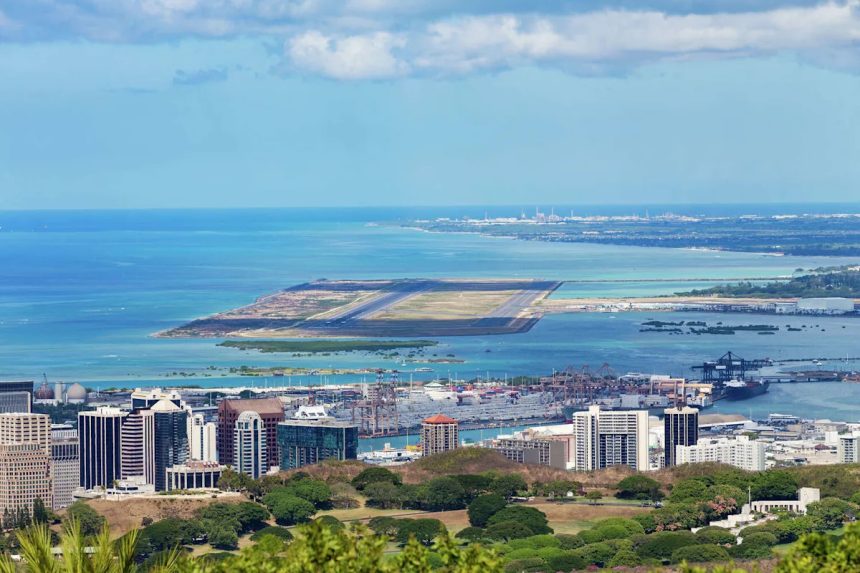
He called police, and in short order they connected the missing person report with a body found around 7 a.m. in Keehi Lagoon, a body of water that fronted the runways of Honolulu Airport. Vicki’s body had seemingly been rolled down from an embankment off Kalewa Street; she had no shoes and no purse.
The killing made front-page news, but leads quickly dried up. It wasn’t until eight months later that the case came surging back to the forefront of detectives’ minds.
Jan. 14, 1986, was supposed to be an ordinary day for 17-year-old Regina Sakamoto, but the teen missed her bus to school. She ducked into a phone booth and made a quick call at around 7:15 a.m. to her boyfriend, letting him know she was running late. She never made it to school.
Regina’s mother didn’t realize until the evening that her daughter was missing. A frantic search was launched – at around 10:30 the next morning, it ended in the worst possible way. A passerby on an access road near the airport saw a body floating in Keehi Lagoon. Like Purdy, Regina’s hands were bound behind her back, and she had been strangled. The bodies were dumped less than a mile apart.
An aerial view of the runways at Daniel K. International Airport and Joint Base Pearl Harbor-Hickam in Honolulu. (kameraworld/Getty Images/iStockphoto)
Fifteen days after Regina was found dead, the killer struck again.
After losing her teen sister in a car crash, joy seemed to be returning to the life of 21-year-old Washington native Denise Hughes. While on vacation in Hawaii, she met a sailor and fell in love. Their whirlwind romance turned into a sudden marriage, and she moved permanently to Oahu just a few months later.
On the night of Jan. 29, 1986, the newlyweds met up for dinner. When the meal was over, they parted ways, Denise back to their home and her husband back to the ship where he was stationed. The next day, she failed to arrive at the telephone company where she worked as a secretary. Three days after she disappeared, fishers found her body floating in Moanalua Stream, a tributary that fed into Keehi Lagoon. Three women, all bound and strangled, all found in the same area – Honolulu police were now sure they had a serial killer on their hands.
The announcement to the public that a police task force had been formed to catch the Honolulu Strangler seems to have sent the killer underground – but only briefly. Two months after Denise was found dead, Louise Medeiros took her last flight.
Louise, 25 years old and three months pregnant, took the short trip from Oahu to Kauai on March 26, 1986. The trip was a bittersweet one: For years, Louise had been the wild child of the family. She had several children with different partners and sometimes was homeless. But lately, things had been looking up, and although she was back on Kauai for the reading of her recently deceased mother’s will, her family noticed Louise seemed more centered.
After a day spent with loved ones, Louise asked for a ride back to the airport. Her family begged her to stay overnight – they fretted about her taking the bus home from the Honolulu Airport at night – but she insisted on getting back to her kids. “She told us not to worry… that she could run away if she was attacked,” her sister said.

An elevated view of the Daniel K. Inouye International Airport on Oahu, with the Pacific Ocean behind. (ozgurcoskun/Getty Images/iStockphoto)
Louise landed back in Honolulu without incident. What happened next is still a mystery. But several days later, a road worker on a freeway overpass near Waikele Stream, about 10 miles from the airport, spotted a woman’s body in the grass. It was Louise, her hands tied behind her back.
As the death toll continued to rise, Honolulu police and the FBI worked on profiling their killer. They believed he was a white man: about 40 years old, no previous criminal record and who lived or worked near the airport. Women were warned not to linger alone at bus stops, as multiple victims had apparently been targeted while waiting for public transportation.
A month after Louise was killed, the fifth and most shocking case hit the headlines.
—
Like most of the other women, Linda Pesce had landed in Hawaii after a childhood in California. She grew up in Kentfield, a town in Marin County, and studied psychology at the College of Marin. But the siren song of a free-spirited hippie lifestyle appealed to Linda, who spent her 20s hitchhiking around the country. She found work as a nightclub dancer in Guam and Honolulu and became pregnant with her daughter in her late 20s. Now 36, Linda was working as a sales rep at an early cellular telephone company. Since having a child, she’d settled down, family members said, but Linda was still as tough and self-assured as ever.
“She’d walk out in traffic and know they’d stop,” her brother-in-law told the Honolulu Star-Bulletin.
On April 29, 1986, Linda stayed late at work, leaving at around 6:30 p.m. in her light blue 1976 Toyota. As far as anyone knows, she never made it home. When a search was launched the next morning, her Toyota was found parked on the shoulder of the Nimitz Highway about 15 minutes from her office. Immediately fearful that she’d been snatched by the Honolulu Strangler, police set up roadblocks and took the unusual step of keeping the car on the roadway, hoping to jog the memory of motorists who may have passed it.
Finally, detectives got lucky. Motorists remembered the car, with some saying it was using its emergency lights. “Lots of people saw her car but they couldn’t tell if she was in it, sitting there,” a police lieutenant told the press. Neither her keys nor her purse were in the car, so detectives thought she may have tried to walk to a service station or a bus stop.
Some witnesses recalled another vehicle: a light-colored van parked near the disabled Toyota.
At Linda’s work desk, her manager found a notepad. On it was the name Howard Andrew Gay, as well as his phone number. It appeared she had been canvassing for new clients near the airport. Gay was working for Flying Tigers, a cargo airline; he drove a white company van.
Police didn’t have to wait long to be in touch with Gay: In fact, he reached out first. In a phone call to police, Gay said he had information that Linda’s body had been dumped on Sand Island, a spit of land just south of Keehi Lagoon. A couple days after Linda went missing, police found her bound and strangled body on that very spot.
If alarm bells around Gay were ringing before, the sirens were now fully sounding. The 43-year-old had grown up in New York state before joining the U.S. Air Force. After his honorable discharge, he moved to Apple Valley, Calif., which at the time was an unincorporated community in San Bernardino County. He married and started a family, but at some point, he moved alone to Hawaii for his job with Flying Tiger; his wife and two sons stayed behind in California.
Police arrested Gay and brought him for a long interrogation. At the end of it, they let him go: Although they strongly suspected Gay was their killer, they had no physical evidence tying him to any of the five crime scenes.
No one could have anticipated what happened next. That summer, while Gay was still under police surveillance, news reached them from California: Gay’s 17-year-old son Jason was dead. The teen was driving in Apple Valley when he saw a stranded motorist on the side of the road. He hopped out to help them, and a driver going about 55 mph didn’t see him. Jason was struck and killed.
Gay traveled back to California, tailed by police, for the funeral. And although he remained a suspect, months turned to years, and police and prosecutors eventually gave up hope they’d ever be able to charge him. Gay continued training aircraft mechanics for Flying Tiger and FedEx, traveling across the globe for work. He died of kidney failure in 2003; his obituary says he was survived by his wife.
Linda Pesce was the last victim of the Honolulu Strangler. In the decades since, two more serial killers have materialized in Hawaii: Only one has been caught. The killings of Vicki Purdy, Regina Sakamoto, Denise Hughes, Louise Medeiros and Linda Pesce remain unsolved.
“From the very time I realized my daughter was murdered, I gave it to the Lord,” Regina’s stepfather Maurice Sakamoto told the Honolulu Star-Bulletin four months after her death. “I have no remorse or bad feelings. I just pray.”
More Hawaii News
– Hawaiians unite to buy back land from billionaire in unprecedented move
– One of Hawaii’s most famous industries is collapsing
– Priscilla Presley is discouraging travel to this Hawaii island
– ‘Total and complete lie’: Longtime Hawaii hotel practice still irks many
We have a newsletter all about Hawaii, with news, tips and in-depth features from the Aloha state. Sign up here.
This article originally published at Hawaii has only 3 known serial killers. This one got away..